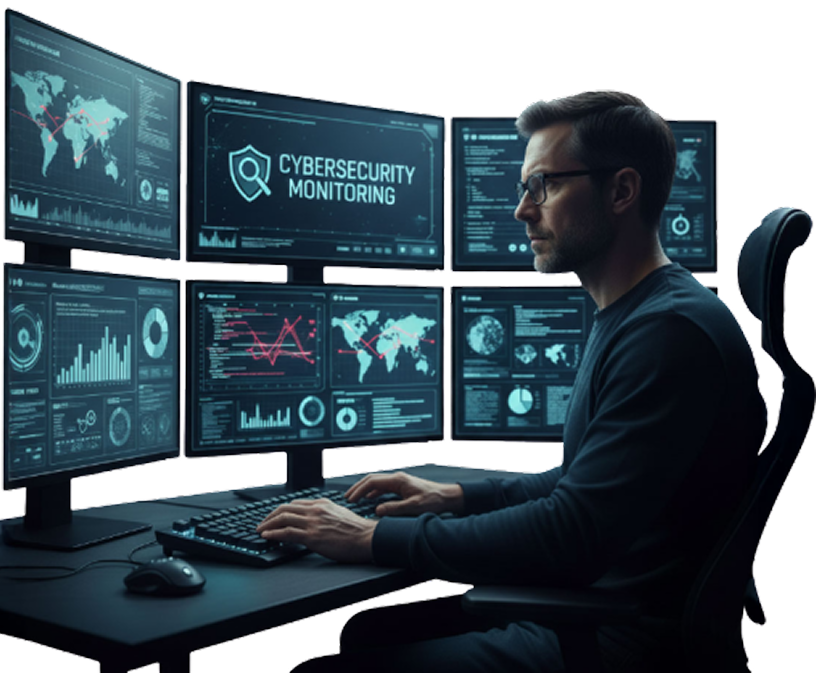
24/7/365 Cybersecurity Monitoring and IT Risk Management
Our Managed Security Operations Center Provides 360° Data Protection Services
- Our Managed Security Operations Center Provides 360° Data Protection Services
- Enterprise-Level Data Protection Services at Fractional Costs
- Get Cloud Security Services, and Endpoint Protection Services
- Benefit from Network Security Solutions, and User Awareness Training
- US-based compliance trained Helpdesk engineers take the first call
How we Approach Managed IT Services
Based On Center for Internet Security (CIS) Framework
To understand how a company approaches security monitoring and management you need to understand the Framework that is being followed in assessing and understanding security posture. Excensure utilizes the Center for Internet Security (CIS) framework as a reference to evaluate your IT environment. We also ensure that your IT follows, at a minimum, best IT practices—resulting in better compliance with standards, superior performance, stronger alignment with business goals, and fewer incidents.
CIS Control Categories Legend
Manage and
Monitor
Security
Policies
Secured
Communication
Device
Security
Access
Control
Data
Collection/Reporting
Click on the following categories to know more..

Inventory and Control of Network Assets
Overview – Actively manage (inventory, track, and correct) all enterprise assets (end-user devices, including portable and mobile; network devices; non-computing/ Internet of Things (IoT) devices; and servers) connected to the infrastructure, physically, virtually, remotely, and those within cloud environments, to accurately know the totality of assets that need to be monitored and protected within the enterprise. This will also support identifying unauthorized and unmanaged assets to remove or remediate.
Objective – Hardware inventories are important for any device accessing the enterprise network. Our goal is to monitor, manage, analyze, and optimize infrastructure assets that are in scope for us to faults, failures, configuration, accounting, performance, and security-related issues. The scope of work that is included in these services is to deploy our monitoring tools, look for faults and failures generated by alerts from the systems, monitor, manage, and patch selected devices for compliance. For mobile devices, MDM tools can be deployed to support this process where appropriate.
Technologies– We will leverage Remote Monitoring and Management platforms to monitor, manage, patch, and remediate selected equipment inventory authorized by the client. The platform allows us to monitor anomalies of systems and provides our engineers the ability to quickly access the device based upon permissions and remediate issues that arise. Additional tools can be deployed for Mobile Device Management, Apple devices, and advanced network analysis if we need additional monitoring.

Inventory and Control of Software Assets
Overview – Actively manage (inventory, track, and correct) all software (operating systems and applications) on the network so that only authorized software is installed and can execute, and that unauthorized and unmanaged software is found and prevented from installation or execution.
Objective – Software assets to be tracked and maintained to include firmware, OS, and common off-the-shelf – COTS applications as well as third-party applications if needed. The purpose is to maintain an inventory of licensed software installed on enterprise assets and periodically review software inventory to ensure it is up to date and accounted for. Ensure that support software is authorized for use in the enterprise and unauthorized software is removed
Technologies – We will leverage Remote Monitoring and Management platforms to monitor, manage, patch, and remediate selected equipment software inventory authorized by the client. The platform allows us to patch and update system software and provides our engineers the ability to quickly access the device based upon permissions and remediate issues that arise. Additional tools can be deployed for third-party applications, Mobile Device Management, Apple devices, and advanced network analysis if we need additional monitoring.

Data Protection
Overview – Develop processes and technical controls to identify, classify, securely handle, retain, and dispose of data.
Objective – Remote access to your systems for outside users and partners is vital for today’s business, but also a fertile avenue for attacks from cyber criminals. The goal of this control is to establish and maintain data management, data-inventory, enforce data retention, encrypt data on end-user devices, and deploy data loss prevention technology to control the movement of data coming and going.
Technologies – We will deploy technologies that will protect, control, and prevent data leaks, monitor user activity, monitor for unknown applications, storage control, insider threats, as well as provide real-time alerts. The technologies we use can provide ringfencing of the data as well as applications to prevent unwanted access to said applications and data.

Secure Configuration
Overview – Establish and maintain the secure configuration of enterprise assets (end-user devices, including portable and mobile; network devices; non-computing/IoT devices; and servers) and software (operating systems and applications).
Objective – To provide a checks and balance roles-based approach to maintain and manage enterprise assets, manage firewalls, manage default accounts, enforce remote wipe capabilities for mobile assets, and configure assets with group policies that are aligned to corporate objectives for the control of assets and software.
Technologies – Our engineer staff and systems use roles-based access to equipment that allows a good check and balance to monitoring and managing corporate assets. Our level 1 analysts can interact with the equipment once alerts are generated while our level 2 engineers have the ability to remediate and manage assets in accordance with corporate guidelines. Our monitoring and management platforms will monitor who has accessed assets and controls.

Account Management
Overview – Use processes and tools to assign and manage authorization to credentials for user accounts, including administrator accounts, as well as service accounts, to enterprise assets and software.
Objective – The goal of this objective is to establish and maintain an inventory of accounts, provide unique and secure passwords to systems, disable dormant accounts, and restrict administrator privileges to select accounts.
Technologies – Our team utilized a secure documentation platform that retains each client’s sensitive data and documentation in a common portal that allows all stakeholders who need to have access, access the information when needed. In addition, the technologies we use allow the stakeholders to create runbooks and offline documentation for audits and attestations when needed. All documentation is structured offering an optimal way for organizing the information to effectively service the team. Access to documentation is controlled through account management and multi-factor authentication processes.

Access Control Management
Overview – Use processes and tools to create, assign, manage, and revoke access credentials and privileges for a user, administrator, and service accounts for enterprise assets and software.
Objective – Establish an access granting process, revoking process, MFA for externally exposed applications, and centralized access controls.
Technologies – When using our team for service operations, you are creating a system of checks and balances where we look for two-man control to allow access for granting permissions based upon roles. Our platforms are all based upon roles base usage controlling and directing the work to the person who is authorized to perform the service. Using our service desk allows the end user to submit requests to onboard and offboard staff as well as to provide and revoke permissions when needed to appropriate systems. In addition, our team can deploy technologies that support multifactor authentication to verify identity in seconds while at the same time protecting applications. In today’s world it is imperative to use unique passwords and monitor exposure and use of those passwords in real-time. Technologies can be deployed to assist users in password management and single sign-on.

Continuous Vulnerability Management
Overview – Develop a plan to continuously assess and track vulnerabilities on all enterprise assets within the enterprise’s infrastructure to remediate and minimize the window of opportunity for attackers. Monitor public and private industry sources for new threats and vulnerability information.
Objective – The goal of this control is to establish and maintain a vulnerability management process for patching, maintaining a remediation process for operating systems and common off-the-shelf applications. Remediate detected vulnerabilities as they arise.
Technologies – Our monitoring and management platforms have the ability for our team to deploy patches and updates to the operating systems, and COT’s software via a management console that allows the team to schedule and maintain control of vulnerabilities for key systems and endpoints. Deployment of our SOC as a Service that can leverage a threat monitoring platform to detect malicious and suspicious activity across the three attack vectors: Endpoint, Network, and Cloud. Our engineers and technology deployed will hunt and investigate threat activity across your systems and perform triage of detections and work with our NOC to remediate when actionable threats are discovered.

Audit Log Management
Overview – Collect, alert, review, and retain audit logs of events that could help detect, understand, or recover from an attack.
Objective – To collect, maintain and retain audit logs for key systems. To Analyze and provide a Security Operations Center (SOC) as a Service in looking for vulnerabilities in the organization.
Technologies – Our engineers will review your logging process and discuss your retention requirements for enterprise assets. We can deploy technologies and a managed monitoring service to collect and analyze logs from key systems looking for vulnerabilities with our SIEM platforms and service.
Deployment of our SOC as a Service will leverage a threat monitoring platform to detect malicious and suspicious activity across the three attack vectors: Endpoint, Network, and Cloud. Our engineers and technology will hunt and investigate threat activity across your systems and perform triage of detections and work with our NOC to remediate when actionable threats are discovered. We have the ability to deploy cloud-based protection services for applications such as Microsoft 365, G Suite, Azure, AWS, Dropbox, and more.
Additional services can include incident response planning, incident response, phishing simulations, as well as forensic services.

Email and Web Browser Protection
Overview – Improve protections and detections of threats from email and web vectors, as these are opportunities for attackers to manipulate human behavior through direct engagement. 86% of all corporate attacks originate through someone’s access to email or the web accessing something that originates as the beginnings of a malware attack.
Objective – Ensure the use of only fully supported browsers and email applications, Use of DNS filtering, restriction of unnecessary or unauthorized email or web browser, Implementation of DMARC, and deployment of email server anti-malware protections such as scanning and sandboxing. In addition, look for suspicious activity of dark web for email domains.
Technologies – Our team can deploy technologies that are intended to protect your web browser and emails from malware and spam, as well as advanced threat protection. In addition, we can use AI technologies to protect from Phishing and business email compromise, account takeover, domain fraud, and DNS filtering. Our dark web monitoring technology helps protect businesses from cybersecurity incidents due to compromised credentials. Our team monitors the dark web in real-time and our systems will issue alerts whenever exposed credentials are found, ensuring end users are notified and defensive measures can be taken before a breach occurs.

Malware Defenses
Overview – Prevent or control the installation, spread, and execution of malicious applications, code, or scripts on enterprise assets. In today’s hybrid work world, the worker is in the office behind the firewall and then working from home.
Objective – We need to provide technologies and services that will constantly protect the user and corporate no matter where they sit. To deploy technologies that will maintain anti-malware software on enterprise assets, Data execution prevention, and actively monitor assets for threats.
Technologies – Most people think malware defense is the deployment of an anti-virus tool. In today’s world is a combination of anti-virus and anti-malware along with zero trust technologies that are deployed to protect corporate assets. Our MDR – Managed Detection and Response and XDR Extended Detection and Response device protection services are backed by a team of 24X7 threat hunters working with our SOC and NOC team to find and remediate real-time footholds and threats as they happen. The AI platform looks for persistent footholds and malware and alerts our team with an action plan to remediate the threat called process insights. Used in conjunction with our SOCaaS platform we look for real-time threats and work together to remediate those threats as they occur.

Data Recovery
Overview – Establish and maintain data recovery practices sufficient to restore in-scope enterprise assets to a pre-incident and trusted state.
Objective – To develop and maintain a data recovery process that will meet the client RTO – Recovery Time Objectives for backups and return to normal operations. Perform automated backups of in scope enterprise assets as well as test data recovery against your RTO. The goal of the backup and recovery strategy is to mitigate the risk of lost systems due to equipment failure or ransomware attacks using good practices of site-to-cloud and high availability requirements for use of information to meet your RTO objective.
Technologies – Our team supports and provides backup technologies that will support your RTO from the endpoint to the data center. In addition, we utilize technologies that monitor changes in configuration files and store that information automatically in our online documentation platform. The technologies we deploy and use are in response to meet your business needs for high availability and recovery of information based on the RTO of the organization.

Network Infrastructure Management
Overview – Establish, implement, and actively manage (track, report, correct) network devices, in order to prevent attackers from exploiting vulnerable network services and access points.
Objective – To ensure the network infrastructure is up to date, monitored, and managed for availability, performance, and security.
Technologies – We deploy technologies that allow our team to monitor, maintain, and manage the network as well as look for performance and documentation. In addition, we can deploy technologies that will allow us to create real-time visualization documentation, IP Address Management, Netflow, SFlow, and JFlow, as well as configuration backups and reporting (What we call Level 3 Analysis).

Security Awareness and Skills Training
Overview – Operate processes and tooling to establish and maintain comprehensive network monitoring and defense against security threats across the enterprise’s network infrastructure and user base
Objective – To centralize security event alerting, look for host-based intrusion detection, segmentation of network assets, collect network traffic flow logs, and deploy host-based intrusion detection solutions such as EDR – Endpoint Detection and Response, port level access control, and application layer filtering.
Technologies – Our Network Operations Center senior engineers will work with the SOC and end-user community to monitor and defend the network. We can deploy next-generation firewalls, processes, and services to defend against security threats across the enterprise. We also can centralize the event alerting through our SOCaaS offering that collects the logs and analyzes the information looking for anomalies and behaviors that are not normal.
Network Monitoring and Defense
Technologies – Our Network Operations Center senior engineers will work with the SOC and end-user community to monitor and defend the network. We can deploy next-generation firewalls, processes, and services to defend against security threats across the enterprise. We also can centralize the event alerting through our SOCaaS offering that collects the logs and analyzes the information looking for anomalies and behaviors that are not normal.
In addition, we can deploy technologies that will allow us to create real-time visualization documentation, IP Address Management, Netflow, SFlow, and JFlow, as well as configuration backups and reporting (What we call Level 3 Analysis).
Service Provider Management
Application Software Security
Incident Response Management
Penetration Testing
Cut Costs, Not Corners with Managed IT Security
Here’s What Our Top-Tier IT Security Services Bring You
Managed IT Security Services are outsourced services provided by a third-party company, like us at Excensure (Called a Managed Security Services Provider or MSSP), to monitor, manage, and remediate essentially protecting an organization’s IT systems and data on the concept of policing and putting out initial fires before they become business burners. We tackle every threat, from cybersecurity to cloud and network security and actively stay informed of zero-day threats so we can apply patches immediately as they are available from the vendors. Unfortunately, not every attack is preventable. So having a company that can respond immediately and mitigate the attack, loss and risk is key to determining the best vendor relationship. If your current vendor is slow with existing issues that are of modest consequence, you need to start thinking about alternatives.
A single cloud misconfiguration can cost you $$$ and reputational loss.
- Top risks: data breaches, account hijacking, insecure APIs
- Ideal for: businesses using AWS, Azure, or Google Cloud
Protect your cloud-based data, apps, and infrastructure from breaches, leaks, and unauthorized access.
A network breach can halt operations and lead to severe financial loss.
- Top risks: DDoS attacks, man-in-the-middle attacks, and intrusion attempts
- Ideal for: organizations with remote teams or complex IT setups
We secure your internal and external networks against unauthorized access and cyberattacks.
IT-related incidents cost businesses an average of $4.45 million—downtime costs alone average $5,600 per minute.
- Top risks: system crashes, ransomware, hardware failures, natural disasters, and vendor software breaches
- Ideal for: sectors relying on digital operations, like finance, healthcare, and e-commerce
We ensure your critical data is always protected and quickly restorable by identifying, assessing, and reducing risks across your IT ecosystem. We work with you to develop essential backup, recovery and disaster recovery solutions sized/costed for your business,
Phishing accounts for over 80% of reported cyber incidents.
- Top risks: credential theft, wire fraud, and malware infiltration
- Ideal for: companies using email as a primary communication tool
We block malicious emails, links, and attachments before they reach your employees.
Compromised data often shows up on the dark web months before a breach is discovered.
- Top risks: identity theft, targeted attacks, brand damage
- Ideal for: companies storing sensitive or financial information
We monitor dark web 24x7 for leaked credentials, customer data, or insider threats tied to your business, and automatically open a ticket the moment your domain shows up on the Dark Web.
Cyberattacks can cost $200K+ on average for SMBs
- Top risks: undetected breaches, lateral movement, insider activity, zero-day exploits, and targeted attacks
- Ideal for: any business facing advanced persistent threats (APTs)
We detect, analyze, and respond to active and emerging cyber threats and anomalies in real time, without depending on your in-house staff.
A single compromised device can be a gateway to your entire infrastructure.
- Top risks: ransomware, device theft, unpatched vulnerabilities
- Ideal for: remote and hybrid teams
We secure and regularly patch devices—laptops, phones, servers—that connect to your network.
95% of breaches involve human error, incurring losses that can reach $4M+ per incident.
- Top risks: phishing, weak passwords, and social engineering attacks
- Ideal for: companies handling sensitive data
We provide comprehensive training to educate employees to recognize and avoid cyber threats so that they can vastly improve their awareness of suspicious emails, texts and other related phishing type events.
Non-compliance can cost you up to $10M+ in fines and reputational damage, and potential prosecution
- Threats include audit failures, unsecured data handling, policy gaps, unrecoverable backups
- Ideal for: regulated and IP-heavy industries and data-driven businesses
We ensure your business meets industry standards like ISO 27001, CMMC, GDPR, HIPAA, or PCI-DSS.
Why Choose Excensure Managed IT Security Services?

Threat Detection and Response
We automate your data protection service so your cyber threat management system can continuously stay on guard to identify and tackle threats like malware, phishing, and distributed denial of service (DDoS) attacks.

Firewall and Antivirus Management
We manage and update your firewalls, antivirus software, perimeter solutions, and endpoint protection service tools to secure every device and network entry point—whether on-site or remote—including updates, security patches, and real-time monitoring.

Security Information and Event Management (SIEM)
We collect, aggregate, and analyze log data from across your organization’s network to identify and detect potential threats early by correlating events in real time using our SIEM and network security solutions. These alerts appear on a single pane of glass and allow for effective 24/7 monitoring, alerting and acting on alerts.

Vulnerability Management
We regularly scan your systems across cloud security services and IT risk management services for known weaknesses, outdated systems, and exploitable flaws, and apply patches or fixes on security gaps.

Incident Response
In the event of a cybersecurity incident, our team of cybersecurity monitoring and cyber threat management experts act fast to contain and reduce the impact of the incident by following proven incident response protocols to minimize disruption and downtime.

Data Loss Prevention (DLP)
Our DLP solutions experts prevent data from being lost permanently, which is especially useful for regulations, compliance, and IP-heavy sectors, where critical and sensitive information is constantly being moved around.

Security Consulting & Risk Assessments
We work with your leadership and IT teams to conduct audits and assess policy gaps in your current security posture, thereby identifying risks and designing customized cybersecurity strategies, policies, and plans that meet industry-specific regulations such as ISO 27001, CMMC, GDPR, HIPAA, PCI-DSS, and more.
Our 5-Step Managed IT Security Process

Consult Our Experts:
Click on the button that says "Consult Managed IT Security Expert” anywhere on the page or reach out to us any time through email, phone, or web forms. We evaluate and audit your current IT infrastructure, identifying vulnerabilities and analyzing business-specific risks.

Assess Your Risks:
Tell us about your problem—don't worry about naming it correctly, we will help you identify the issue in-depth. Our experts keep meticulous records of disasters and security events, which they can use to help you identify the nature of the solution you want to implement.

Plan and Strategize:
After identifying your problem, our IT security service expert will help you assess its location—whether cybersecurity, cloud, network, or endpoint—and come up with several solutions, based on the immediacy—whether resolvable easily or requiring complex steps like for a ransomware—of the issue.

Protect and Respond:
Once you implement one of our tailored yet holistic solution approaches, we immediately begin scanning your IT ecosystem to detect threats, respond to them in real time, and protect you from damage in millions of dollars. By acting fast, we contain attacks rapidly and reduce their impact.

Recover and Improve:
Finally, our experts produce reports including tools and security layers used and recommend actions in cloud security services, network security solutions, IT risk management, data protection services, cyber threat management, endpoint protection services, and security compliance services to prevent further recurrence.
FAQ
Frequently Asked Questions
Excensure’s IT security service is a managed IT security approach, which means that it provides more than traditional antivirus and firewall, which offer basic, device-level, manual protection by blocking known threats like malware and unauthorized access. Managed IT security is a scalable, enterprise-grade service that protects your entire IT environment—including networks, endpoints, cloud, and data—24/7 in real time.
We help defend your IT networks against a wide range of cyber threats like malware, ransomware, phishing, social engineering, DDoS (distributed denial of service) attacks, insider threats, zero-day exploits, credential theft, account compromise, advanced persistent threats (APTs), dark web exposure, data leaks, and unauthorized access by combining tools, expertise, and incident response systems like cyber threat management and cybersecurity monitoring.
Yes, we can absolutely help you meet and maintain compliance with industry regulations like CMMC, HIPAA, GDPR, SOC 2, and others. As a managed IT security service provider, we identify gaps in your security posture that could lead to non-compliance and help define and implement security policies, procedures, and access controls required by regulatory frameworks, and keep up with evolving regulations and update your security posture accordingly.
As a managed IT security service provider, we employ advanced tools and systems to monitor your IT network and endpoints 24/7 in real time, thereby detecting potential security threats early and containing them quickly before they can attack. In the case of post-attack response, we also investigate its source and guide your recovery with post-incident reports to help you understand the source and improve future defenses.
For IT security services, we specialize in small to medium-sized businesses in regulation-heavy or online operation-based industries that lack the resources to maintain full-time in-house security teams, like finance, legal, manufacturing, or retail. We also cater to large enterprises in e-commerce, government, and healthcare that require 24/7 cybersecurity monitoring.
Yes, absolutely, managed IT security is actually one of the most cost-effective, holistic security solutions for small to medium-sized businesses (SMBs) as they can access 24/7 coverage and cybersecurity monitoring, specific enterprise-grade expertise and tools, and faster threat response, along with security compliance services and IT risk management at a piecemeal price.
To get started with Excensure’s IT security services, just click on the button that says "Consult Managed IT Security Expert” anywhere on the page or reach out to us any time through email, phone, or web forms, and tell us what you need to know, and we will take care of the rest.