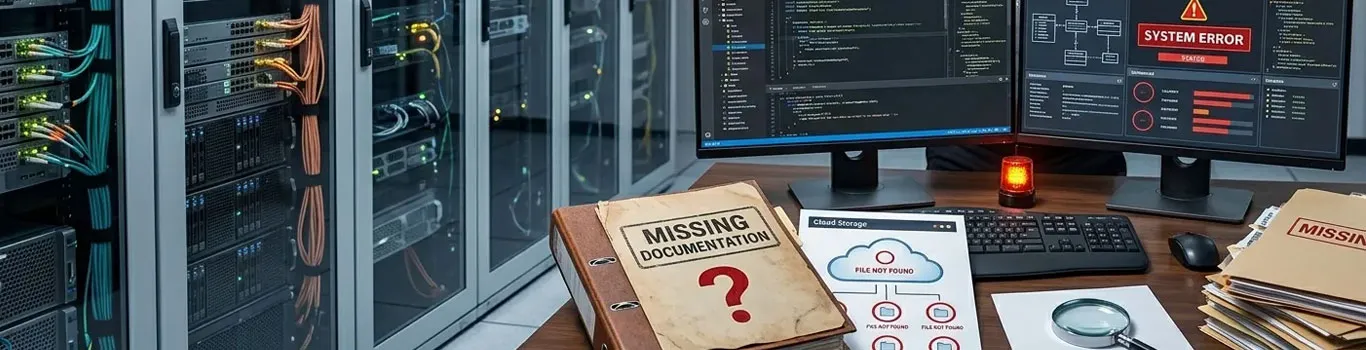
The Silent Risk in Your IT Environment: Missing IT Documentation
Typically, small and medium companies have a very efficient person handling IT. Someone who knows the systems and can often resolve crises quickly whenever they occur.
However often times the critical glue of all IT is undervalued and underserved. Documentation.
Documentation is one of the most important aspects of mitigating company risk.
The following scenarios are examples of its criticality:
- Troubleshooting: When documentation is not current, problem resolutions are not part of reusable knowledge base for reference to ensure the same or similar issues are quickly resolved. In addition, no third-party vendor can come in and assist. For example, no one other than the main IT person knows the passwords or system configurations.
- Procedures: When procedures are not current the company runs the risk of having employees following ineffective or non-documented procedures.
- Compliance/Cyber Liability: When documentation is not complete, companies run the risk of being out of compliance and not satisfying the requirements of Cyber Liability insurance.
- Accountability: when procedures and policies are not current or documented, employees cannot be held accountable for actions that would otherwise be violations of documented policies.
- Liabilities: Policies that are not documented or current create company liabilities based on employees who behave outside the bound of good corporate behavior. This could include downloading confidential company/client data.
- Governance: good governance is built upon the documentation of policies and procedures. One of the goals is to always maintain their currency through regular reviews.
Ultimately what is at risk is company chaos, finger-pointing, process disruption, operational delays, loss of revenue, and possibly a very expensive cyberattack.
Good document management practice isn’t about paperwork. It is the foundation of a stable IT environment. But if it is so vital, why do most SMBs lack it? Let’s understand that next.
Why SMBs Usually Lack Documentation
Most SMBs are high-growth organizations. They like to run lean and often have small teams. Moreover, they often lack the budget to invest in IT and therefore rely on legacy infrastructure. And since they experience very fast growth, they often find it difficult to create detailed documentation that would formalize their IT processes.
If you are also experiencing a similar situation, we understand what you are going through. But the truth is, running your business without documentation is very bad behavior, and hoping you never have to deal with the consequences is just wishful thinking. The question no longer remains “whether.” It is “when.” When will your business face a disaster whose origin lies in non-existent or poor documentation.
How Documentation Makes a Real Difference
But everything changes when you follow good document management practices. Here is a list of several benefits that documentation brings:
- Business Continuity
. Good document management practices ensure that you continue to operate irrespective of whether your key IT resource is there or not.
- Faster Troubleshooting
Ticketing Systems: You, of course, do not want your technicians to hunt for solutions every time a problem occurs. Documentation reduces downtime. Technicians can resolve issues faster when configurations, dependencies, and system histories are documented.
- Stronger Security
Documented policies around security protocols and access controls help maintain consistent protection against cyber threats because everyone in the business now knows what to do and what not to do to keep the organization protected against cyberattacks.
- Compliance and Audit Readiness
Many frameworks, like ISO 27001, require documented IT processes and controls. So, the lack of clear documentation increases IT risk and governance issues.
- Knowledge Transfer
Documentation prevents knowledge loss when employees leave or roles change. Good document management practices also make it easier for new engineers or IT providers to understand the environment quickly, making onboarding a more seamless experience.
- Operational Efficiency
Clear documentation standardizes processes and reduces time wasted searching for solutions. This means your employees waste less time looking for solutions and more time actually implementing them, thereby boosting operational efficiency.
- Scalability
Well-documented systems make it easier to scale infrastructure and integrate new technologies.
Now that you know why your IT processes needs clear and good documentation comes the most important question “what needs to be documented?” We will explore that in the next section.
What Should Be Documented
Here is a list of things that you should document:
- Asset Inventory
- System Configuration
- Network Diagrams
- Access Controls
- Change Management Logs
- Policies and SOPs
We know that with all said and done, you will still find documentation management harder to execute. And therefore, you might prefer to stick with undocumented processes that you have been following to date. But what if you could have a professional handling your documentation management with finesse?
Yes, that’s what Excensure offers. Here is a brief overview of how our expert team works with you to overhaul your document management process.
How Excensure Helps
Here is a list of defining features of Excensure’s document management system:
- Centralized Repository
Our system offers one secure location for all your governance and compliance documents. That means no more chaos while storing or retrieving documents.
- Version Control & Audit Trails
Our document management system lets you track who made changes, when, and why—with a full audit trail for every document. So, you don’t have to waste time or resources searching for the right version. Moreover, clarity over work ownership means less blame game, minimal time waste, a better workplace environment, and increased efficiency.
- Secure Access Management
We take security very seriously. Therefore, our in-built role-based permissions feature ensures only authorized personnel can view or edit specific files. So, no more security risks.
- Automated Workflows
We believe that you should have more time to focus on what matters most, not chase unnecessary work. Therefore, our in-built automation streamlines document approvals, renewals, and reviews.
- Regulatory Alignment
We believe compliance hassles should not derail what you are building. That’s why our government document management system takes care of IT risks and compliance issues, ensuring compliance with HIPAA, CMMC, GDPR, and more. That means no more compliance hassles.
- Cloud & On-Premise Flexibility
We let you choose the deployment model that fits your security and access preferences. Because you should have control in your hands.
Final Words
Most SMBs avoid documentation. For them, it’s important paperwork that rarely makes it to the top of the list, unless there is a pending audit. But good document management practices are not just for periodic compliance audits or quarterly business review meetings.
It is the foundation of a stable IT environment. It is so fundamental that Excensure has a Professional Documentation writer who is assigned out to clients for just these tasks.
- Review the current documentation
- Determine gaps and make recommendations on the best roadmap to develop the proper documentation.
- Execute that documentation work closely with the client.
- Help the client to develop a process to keep documentation current.
We know documentation can feel like a hassle and can take a significant amount of your time. That is why the best way forward is to let a managed service provider like Excensure take care of it. If you are still unsure or have not figured out how to go ahead with it, click on the Free Discovery Call button at the top right-hand side of this page and fill in your queries.
We will call you back shortly for a free, no-obligation consultation with our experts.
Don’t wait for a system failure or audit crisis to expose gaps in your IT environment. If you want expert guidance on building a stable and well-documented IT environment, click the link now and book your free discovery call.